ELLEx: The Difference Between AI in a Legacy Solution and a Solution Built for AI
Every legal software vendor today talks about AI. Chatbots, drafting assistants, “smart” search, the features sound similar on a slide. But there is a fundamental difference between adding AI on top of an existing system and building a system so that AI can actually use it. That difference decides whether AI in your practice management software becomes a genuine daily tool, or stays a nice-looking demo.
Two Very Different Starting Points
Most legal software in use today was designed years, sometimes decades, before generative AI existed. Cases, documents, emails, deadlines, and billing data live in separate modules, often connected only loosely. When a vendor then “adds AI,” what usually happens is a chat window bolted onto the surface. It can search a document here, summarize a text there. But it cannot see the whole picture, because the underlying data was never structured to be understood as a connected whole.
ELLE X takes the opposite approach. It was rebuilt from the ground up with an AI-ready, semantic data model, so that clients, cases, documents, emails, deadlines, and billing records are connected by design, not stitched together afterward. AI running on ELLE X can therefore work with the complete, authorized case context: previous matters, related documents, communications, and deadlines together, instead of reading isolated files one at a time.
What Actually Changed Underneath
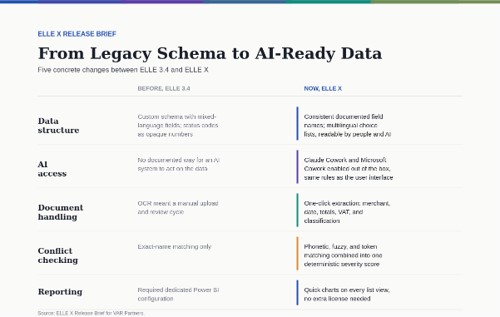
This isn't just a marketing claim. It shows up in concrete, practical differences between the previous generation of ELLE and ELLE X:
- Data structure: the old system used a custom schema with mixed-language fields and status codes stored as opaque numbers. ELLE X uses consistent, documented internal names with multilingual choice lists, structured so both people and AI can reliably interpret every field.
- AI access: previously, there was no documented way for an AI system to act on the data at all. ELLE X ships with AI assistants (Claude Cowork and Microsoft Cowork) enabled out of the box, reading and writing through the same rules, validations, and permission checks as the regular user interface, so nothing an AI does bypasses a control a human would otherwise have to pass.
- Document handling: OCR used to mean a manual upload and review cycle. In ELLE X, dropping in a receipt or document is a one-click action: merchant, date, totals, VAT, and classification are extracted automatically.
- Conflict checking: the previous system matched only exact names. ELLE X combines phonetic matching, fuzzy matching, and token similarity into one deterministic, explainable severity score, catching variations a simple text search would miss entirely.
- Reporting: getting a chart used to require dedicated Power BI configuration. In ELLE X, every list view generates a quick chart automatically, with no extra license needed for the basics.
Why This Matters in Practice
Imagine asking an AI assistant to summarize the status of a case. On a legacy system with AI added on top, the assistant can typically only read what is directly in front of it, perhaps the open document, or a single email thread. It has no reliable way to connect that to the client's history, related matters, or upcoming deadlines, because that connective structure simply doesn't exist underneath.
On a system built for AI, the same question can draw on the full, authorized context around a matter, because clients, cases, documents, deadlines, and communications are already linked in the data itself. The answer is not just faster, it is more complete and more relevant, because it is grounded in the actual working reality of the case, not just the document that happens to be open.
Built Into the Firm's Own Microsoft Environment
There is a second dimension to this difference: control. AI that is bolted onto a legacy system often means data has to leave the firm's own environment to be processed elsewhere, raising questions about confidentiality, governance, and where sensitive legal information actually resides.
ELLE X runs inside the law firm's own Microsoft environment, so data, permissions, and governance stay under the firm's control throughout. Every action an AI assistant takes, creating a time entry, attaching a document, confirming a deadline, drafting an invoice, is logged with the user and the AI environment that initiated it, in the same unified audit trail as any manual action. AI capability and data sovereignty are not a trade-off, they are designed to work together.
The Bottom Line
Adding AI to a legacy system can make individual tasks feel a little faster. Building a system so AI can genuinely understand the case as a whole changes what is possible: a workspace where lawyers and staff work around the matter itself, supported by AI that sees the full picture, rather than switching between disconnected tools and hoping the AI catches up.
That is the real difference between AI in a legacy solution, and a solution built for AI.
ELLE X is Logol's legal ERP and DMS platform, designed case-centric and AI-ready from the ground up, fully integrated into the firm's Microsoft environment.