Microsoft Foundry: What It Is and What AI Agents Actually Do All Day
Microsoft has quietly consolidated years of separate AI services, Azure AI Studio, Azure AI Search, and a growing list of agent tools, into a single platform: Microsoft Foundry. If Microsoft Fabric is where a company's data lives, Foundry is where that data gets put to work through AI agents. It is, in Microsoft's own words, the platform to build, ground, and govern AI apps and agents at scale. That description is accurate but abstract. The more useful question for most businesses is simpler: what does an AI agent built on something like Foundry actually do, on a normal Tuesday, inside a normal company?
First, What Foundry Actually Is
Foundry brings together everything needed to build an agent under one roof, instead of stitching together separate tools yourself:
- Foundry Models: a catalog of more than 11,000 models, from OpenAI, Anthropic, Meta, Google, and others, so a team can pick the right model for the task instead of committing to just one
- Foundry Agent Service: the managed platform that actually runs an agent once it's built, handling identity, scaling, and monitoring so a team doesn't have to manage servers and containers themselves.
- Foundry Tools: more than 1,400 pre-built connections to real business systems such as SAP, Salesforce, and Dynamics 365, so an agent can act on live data instead of only reading static documents.
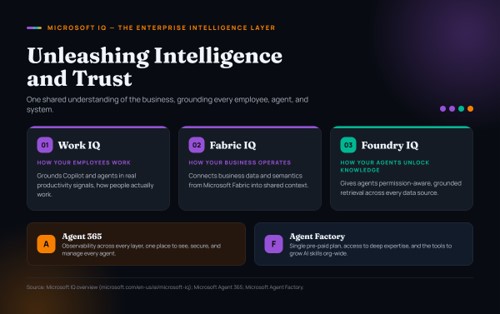
- Foundry IQ: a shared knowledge layer that lets an agent pull grounded, permission-aware answers from a company's own SharePoint, data stores, and internal systems, respecting exactly who is allowed to see what.
- Foundry Control Plane: the governance layer, giving IT one place to see, monitor, and secure every agent running across the organization.
Put simply: Foundry is less a single product and more a factory floor. Models are the raw material, Agent Service is the assembly line, Tools and IQ connect the agent to the rest of the business, and the Control Plane makes sure nothing runs unsupervised.
So What Does an Agent Actually Do All Day?
This is where it becomes concrete. An AI agent isn't a chatbot sitting in a corner waiting for someone to ask it something. In practice, a well-built agent works more like a very fast, very literal junior colleague running in the background:
- It monitors an inbox around the clock. A support or client-request agent reads incoming emails as they arrive, understands what's being asked, checks the relevant system for the answer, and either replies directly or drafts a response for a human to approve, instead of waiting in a queue until someone has time.
- It watches for a trigger and acts on it. An invoice lands in a shared folder, a new contract is uploaded, a deadline in a case management system approaches. The agent notices the event the moment it happens and starts the next step automatically, rather than relying on someone remembering to check.
- It pulls information from several systems and assembles it. Instead of a person manually copying numbers from a CRM, an ERP, and a spreadsheet into one report, an agent connects to all three, gathers what it needs, and produces the summary or report on its own.
- It answers questions using a company's actual knowledge, not general assumptions. Because it is grounded in the company's own documents and data through something like Foundry IQ, it doesn't guess. It retrieves the actual policy, the actual clause, the actual number, and cites where that answer came from.
- It escalates what it shouldn't handle alone. A well-designed agent knows the edge of its own competence. Routine requests get handled directly; anything unusual, high-risk, or ambiguous gets flagged to a person, with the context already prepared so the human doesn't have to start from zero.
None of this requires the agent to be “intelligent” in a dramatic sense. It requires it to be reliable, to have access to the right systems, and to know exactly where its authority ends. That is precisely what a platform like Foundry is built to guarantee: not just that an agent can act, but that it acts inside clear boundaries, with every action traceable afterward.
Why the Governance Side Matters as Much as the Agent Itself
It is easy to focus on what an agent can do and forget to ask who is watching it. This is arguably the more important part of Foundry's design. The Control Plane gives an organization one place to see every agent that is running, what it has access to, and what it has actually done, integrated directly with Microsoft Entra for identity and Microsoft Purview for data governance. Every agent interaction can be traced end to end, with built-in checks for whether a response was accurate, relevant, and safe.
That matters because the moment an agent can read a mailbox, touch a CRM record, or file a document on someone's behalf, it stops being a convenience feature and starts being a system that needs the same oversight as an employee with access to those same systems.
What This Means for a Law Firm
The same pattern applies directly to legal practice, just at a smaller and more specific scale. An agent built on this kind of foundation could watch for an incoming client email and draft a first response grounded in the actual case file, flag a deadline the moment it's set rather than relying on someone remembering it, or pull together a status update across several matters without a paralegal manually assembling it by hand.
This is exactly the principle ELLE X is built around: AI agents that work inside the firm's own Microsoft environment, grounded in the firm's real client, case, and document data, acting inside clearly defined boundaries, and handing off to a person the moment something falls outside routine work. The technology behind Foundry and the philosophy behind ELLE X point in the same direction: agents earn their place not by being clever, but by being dependable, transparent, and governed.
Sources: Microsoft Foundry product page (azure.microsoft.com/en-us/products/ai-foundry); Microsoft Foundry Agent Service overview; Foundry IQ product documentation (Microsoft Learn); Microsoft Agent 365 overview.