The New Microsoft Fabric: What It Means and How It Transforms Your Company
For years, companies have built their data landscape out of separate pieces: one tool for storage, another for warehousing, another for real-time analytics, another for reporting, another for governance. Every piece works, but connecting them, keeping data in sync, and trusting the result across the organization has become its own full-time job. Microsoft Fabric is Microsoft's answer to that fragmentation: one unified data platform for AI transformation, built to close that gap.
One Platform, Instead of Many
Fabric brings together the tools that used to live in separate products, Data Factory, Analytics, Databases, Real-Time Intelligence, and Power BI, on a single, shared foundation. At the center sits OneLake, one logical data lake for the entire organization, so data no longer needs to be copied and re-copied between systems just so different tools can use it. Governance and Copilot sit alongside it as part of the same platform, not as separate add-ons bolted on afterward.
The practical effect: instead of data engineers, analysts, and business users each working from their own version of the truth, everyone works from the same underlying data, governed once, used everywhere.
Why This Matters Right Now
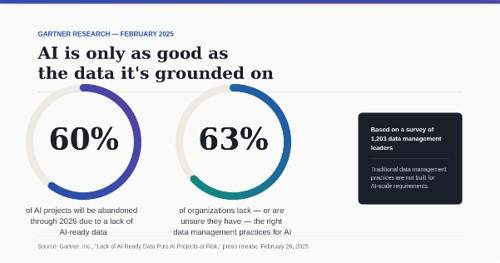
This isn't just a tidier way to store data. It is becoming the precondition for AI actually working. Gartner has projected that a majority of AI initiatives will be abandoned through 2026 simply because the data behind them wasn't ready, not because the AI model itself failed.
Separate research points the same direction: a large majority of senior business leaders say their organization's AI adoption would move faster with stronger data infrastructure in place, and most top-performing companies have already invested in modernizing their data foundation.
The pattern is consistent: AI is only as good as the data it's grounded on. A brilliant AI assistant sitting on top of scattered, inconsistent, poorly governed data will always produce shallow, unreliable answers, no matter how advanced the model behind it is.
What “AI-Ready” Actually Requires
Microsoft frames the ambition behind Fabric around three ideas: unifying the data estate, giving that data real business semantics and context, and using that foundation to empower AI agents. In practice, that means an AI agent shouldn't just be able to search a document, it should be able to understand what a “client,” a “case,” or a “deadline” actually means in the context of your business, because that meaning is built into the data itself, not left for the AI to guess at.
That is also precisely where many organizations get stuck. Most companies are still somewhere between having siloed, limited-quality data and setting up their first real AI infrastructure, miles away from an AI-native platform where every team works from a governed, unified data foundation. Getting from one end of that journey to the other is less about buying more AI tools, and more about doing the less glamorous work first: making data readable, connected, and trustworthy.
The Connection to Legal Practice Management
This is not an abstract data-engineering problem, it applies directly to how a law firm's own systems are built. A platform like ELLE X follows exactly this principle at a smaller, more focused scale: cases, clients, documents, emails, deadlines, and billing records connected in one AI-ready data model within the firm's own Microsoft environment, rather than scattered across disconnected modules with AI hoping to bridge the gap afterward.
The lesson from Fabric applies just as much to a law firm's practice management system as it does to a global enterprise data estate: AI only delivers real value once the data underneath it is unified, understood, and trustworthy. Everything else is a demo.
Sources: Microsoft Fabric platform overview; Gartner, “Lack of AI-Ready Data Puts AI Projects at Risk,” February 2025; EY research on AI adoption and data infrastructure.