How to Become a Frontier Firm When It Comes to AI
Microsoft has given a name to the organizations that are pulling ahead in the AI era: Frontier Firms. It's a useful term, because it describes something more specific than “using AI a lot.” A Frontier Firm isn't defined by how many AI tools it has bought, it's defined by how deliberately its leaders have redesigned work itself around AI, deciding function by function where humans lead, where AI leads, and where the two work together.
Frontier Firm or Fast Follower? Both Are Reasonable, Moving Blind Isn't
Harvard Business School's Karim Lakhani frames the choice many leadership teams face today as Frontier Firm versus Fast Follower: reinvent the organization around AI now, or scale proven patterns faster once they're clearer. Both are legitimate strategies. What isn't legitimate, in his framing, is moving without learning, adopting AI quickly or slowly without building the organizational muscle to understand what's actually working.
That distinction matters because the pressure to act is real. Analysts expect the number of AI agents in active use to reach into the billions within the next two years, the large majority of organizations plan to integrate them within one to three years, and a significant share of enterprise applications are expected to embed task-specific agents in that same window. The direction of travel isn't in question. How deliberately a firm moves through it is.
What Actually Separates a Frontier Firm
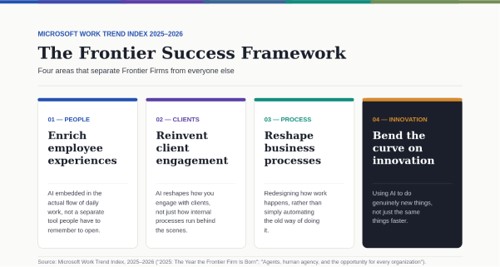
According to Microsoft's own research, only a small share of organizations today qualify as genuinely “Frontier,” most are still in an earlier, “emergent” stage. The gap isn't access to AI tools; nearly everyone has that now. The gap is in four areas that Microsoft's framework calls out consistently:
- Enriching employee experiences: AI embedded in the actual flow of daily work, not a separate tool people have to remember to open.
- Reinventing engagement: with clients, not just internal processes.
- Reshaping business processes: redesigning how work happens, rather than automating the old way of doing it.
- Bending the curve on innovation: using AI to do genuinely new things, not just the same things faster.
Underneath all four sits a less exciting but non-negotiable foundation: data that AI agents can actually understand, security and governance built in from the start, and the flexibility to bring in new AI capability without re-platforming every time something better arrives.
The Uncomfortable Part: Most of the Work Isn't About AI
This is the part that surprises many leadership teams. Becoming a Frontier Firm is described by Microsoft's own maturity model as a journey through five stages, from siloed data with no AI-specific infrastructure, through initial pilots, to a production-capable platform, and eventually to an enterprise-wide, continuously optimized foundation. Every one of those stages is defined by data readiness, not by which AI model a company has adopted.
That's consistent with what the broader research shows: a large share of senior leaders say their AI adoption would be faster with stronger data infrastructure in place, and most top-performing companies have already invested in exactly that kind of modernization before scaling AI further. The firms furthest along aren't the ones with the most AI subscriptions. They're the ones whose data was ready to be used by AI in the first place.
Where This Meets Legal Practice
For law firms, the same logic applies at a more concrete, everyday level. Becoming AI-forward doesn't start with picking a chatbot, it starts with whether client, case, document, and deadline data actually sits in a structure AI can use in the first place. That is exactly the principle behind ELLE X's AI-ready data model: connecting the firm's clients, cases, documents, and deadlines so that AI has real context to work with, rather than isolated fragments.
Becoming a Frontier Firm, in other words, isn't about adopting the newest AI feature first. It's about building the foundation, data, governance, and deliberately redesigned workflows, so that whichever AI capability comes next can actually be put to use, immediately and reliably, instead of staying a demo on a slide.
Sources:Karim Lakhani (Harvard Business School / Digital Data Design Institute),Microsoft Work Trend Index 2025–2026; IDC; Capgemini; Gartner; EY.