Information Disorder
Depending on how you choose to read it, compliance takes on very different meanings and roles. It is not a brake, and it can even become an opportunity for innovation. An opinion piece by Alessandro Maserati, Head of AI at Logol.
In 2026, the main obstacle to adopting artificial intelligence in companies is not compliance, but information disorder. Talking about compliance comes naturally: the word evokes procedures, responsibilities, controls and audits. Yet that very visibility risks turning it into a convenient explanation, and not necessarily an accurate one.
Compliance comes at a cost. It takes time, requires documentation and additional controls, and demands greater care in managing responsibilities. But reducing it to a brake would miss the point. Properly understood, it forces companies to clarify the questions that determine whether AI can be used reliably: who is responsible for a given piece of data, where it is stored, who may access it, how current it is, how it is protected, and through which processes it enters the life of the business.
When you ask an AI system to prepare a proposal, analyse a case file, draft a report, summarise a commercial position or automate an internal procedure, you are not simply asking it to produce a well written text. You are asking it to operate inside the specific reality of your organisation.
To do that, the system needs to know where to look, which documents count as valid, which versions are obsolete, which internal rules apply and which decisions have already been made. Without that context, even the most advanced model can produce an elegant and convincing answer that does not match operational reality.
Company information therefore has to meet three conditions: it must exist in digital form, be accessible to whoever is authorised to use it, whether person or machine, and be consistent across sources. If even one of these conditions is missing, the effectiveness of AI drops sharply.
In digitalisation projects, AI implementation very often fails not because of the technology itself, but because the necessary information is not available digitally, not accessible, or inconsistent. A great deal of information does not yet exist in any usable form. It lives in conversations between colleagues, in the experience of long serving staff, in operational habits, in exceptions passed on by word of mouth, in paper documents or in forgotten local archives. To someone who has worked in the company for years, this knowledge feels obvious. To an AI system, whatever is not digitised and retrievable simply does not exist.
Other information does exist but is inaccessible or has been forgotten. Other information again is inconsistent: different versions of the same document, procedures updated only in part, instructions that contradict one another. Faced with that ambiguity, AI can flag discrepancies, but it cannot stand in for governance that is missing.
The real challenge, then, is not just to introduce AI, but to make the company legible to AI. That means turning scattered, tacit or contradictory knowledge into a structured, current and accessible information asset. It means establishing which source takes precedence, who is responsible for keeping it up to date, which content should be retained or deleted, and which decisions should become knowledge.
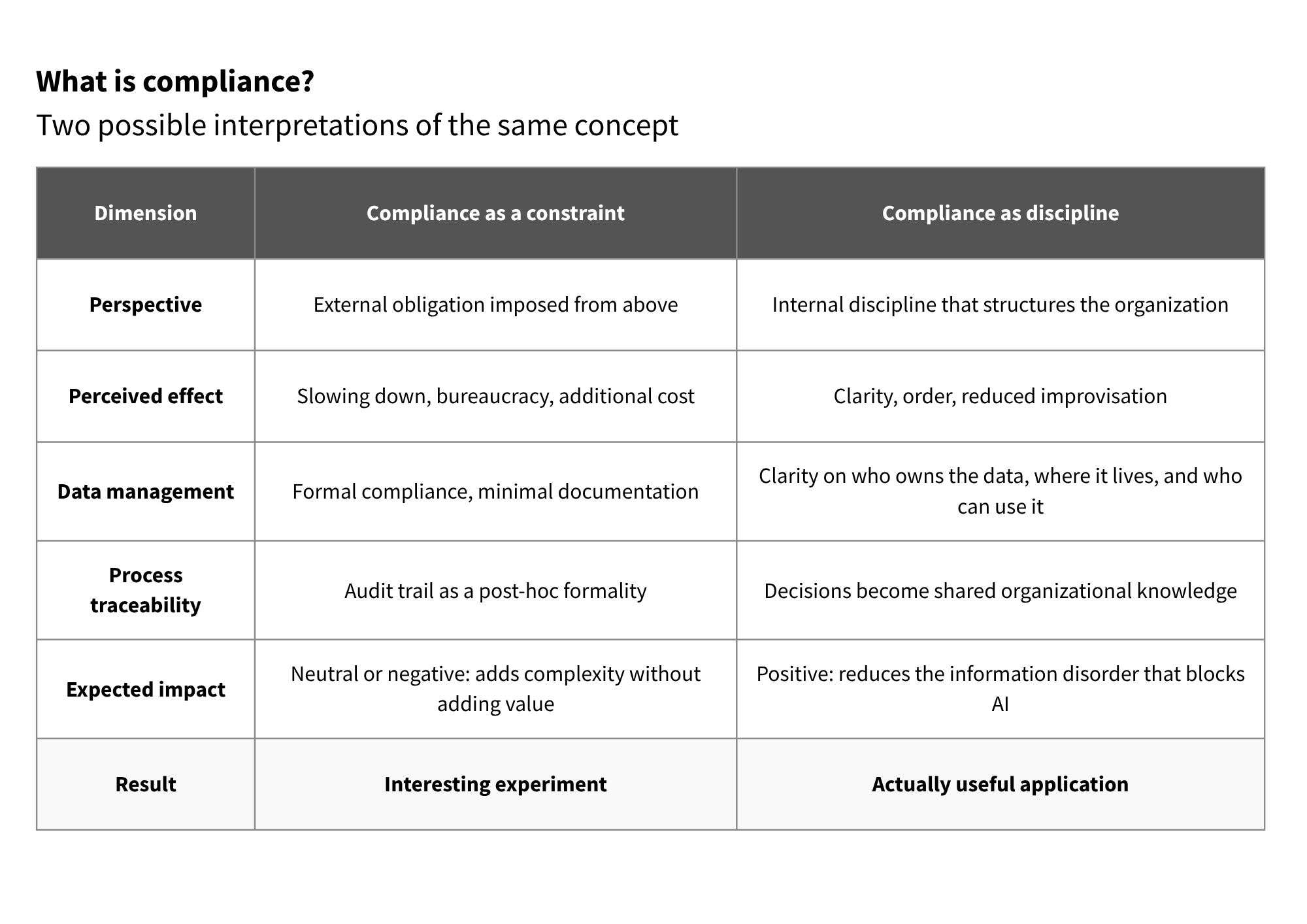
Compliance takes on a different meaning in this light. Experienced only as an imposed obligation, it will continue to feel like a burden. Understood as organisational discipline, it becomes one of the most practical routes to reducing information disorder.
Caution must not turn into paralysis, but innovation cannot be built on improvisation. AI does not work with the knowledge a company assumes it has, but with the knowledge it has managed to make available, accessible and consistent. That, far more than compliance, is where the real challenge lies today.
The original article in italian: https://www.eidosmedia.ch/it/ticino-management/il-disordine-informativo/