ELLEx: Switzerland's New AML Rules and What They Mean for Your Firm
On October 1, 2026, two pieces of Swiss legislation come into force that change who has to run anti-money-laundering checks, and how thoroughly. The revised Anti-Money Laundering Act (GwG) and the new Transparency of Legal Entities Act (TJPG) close a gap Switzerland has been under international pressure to close for years. For many law firms, trustees, and advisors, this is genuinely new territory, not a minor update to an existing process.
Why Now: The FATF Background
Switzerland has been a member of the Financial Action Task Force (FATF) since 1990, and its anti-money-laundering framework is reviewed by the FATF on a regular cycle. In its fourth country review in 2016, the FATF found that Switzerland only partly met Recommendation 22, the requirement that certain non-financial businesses and professions (“designated non-financial businesses and professions,” DNFBPs), including lawyers, notaries, trustees, and real estate agents, be subject to proper due-diligence and reporting duties. The specific problem: a range of advisory activities in Switzerland simply fell outside the GwG entirely, as long as the advisor never personally handled client funds.
That gap has real consequences. The number of suspicious-activity reports filed by lawyers and notaries has been falling, with only two filed in 2022, a figure that looks increasingly hard to justify given repeated international data leaks showing structuring and advisory work being used to obscure ownership. In its most recent country report from October 2023, the FATF upgraded Switzerland's rating from “Partly Compliant” to “Largely Compliant,” a step forward, but not yet full compliance. The next FATF evaluation is expected around 2027, which is part of why the timeline for this reform has been under pressure.
The reform also implements FATF Recommendations 24 and 25, which require transparency around the beneficial ownership of legal entities and legal arrangements such as trusts. That is exactly what the new TJPG register is built to deliver.
What Actually Changes: A New Category of Regulated Advisor
The GwG revision creates an entirely new category of regulated party: “Beraterinnen und Berater” (advisors). Two criteria determine whether a given engagement falls under this new obligation:
- Professional capacity: the activity is carried out commercially and for payment.
- Type of activity: the advisor is professionally involved, for a third party, in a transaction carrying meaningful money-laundering risk, specifically company formation and structuring, real estate transactions, and matters involving foundations, regardless of whether the advisor ever personally holds or moves the client's money.
One detail matters more than it first appears: the point at which a mandate becomes regulated can be earlier than expected. Once a transaction's essential shape is clear and the advisory work is aimed at carrying it out, the obligation can begin as early as the engagement itself, not just once documents are signed.
There is an important carve-out. Lawyers and notaries remain exempt from these duties for work connected to court, criminal, administrative, or arbitration proceedings. Litigation and pure legal representation are not affected. Structuring and transaction advisory work is.
The Three Core Duties, and What Must Actually Be Checked
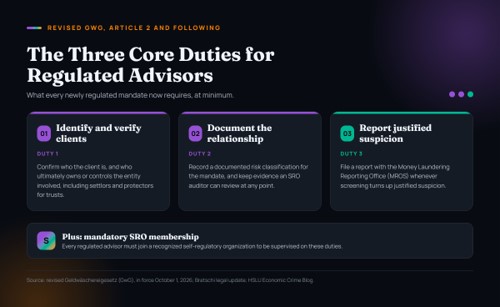
Once a mandate is regulated, three core due-diligence duties apply: identifying and verifying the client, documenting the business relationship, and filing a report when there is justified suspicion of money laundering. On top of that, regulated advisors must join a recognized self-regulatory organization (SRO).
In practice, this breaks down into five concrete checks at every mandate intake:
- Triage: does this mandate fall into a regulated category, and is it being carried out professionally? This has to happen at intake, not after the fact.
- Client identification and verification: who is the client, and has that identity actually been verified?
- Beneficial ownership: who ultimately owns or controls the entity involved? For trusts, this extends further, covering the settlor, trustee, protector, and beneficiaries.
- Documented risk classification: how much money-laundering risk does this specific mandate carry, and is that assessment written down?
- Suspicious activity screening: is there anything that meets the threshold for a report to Switzerland's Money Laundering Reporting Office (MROS)?
The TJPG register adds a further layer of specificity: for every beneficial owner, the register must capture name, date of birth, nationality, address, and the nature and extent of their control, a level of detail that is easy to promise on paper and considerably harder to maintain consistently by hand across an entire client base.
Professional Secrecy Is Still Protected
The reform is explicit that oversight of lawyers and notaries has to respect professional secrecy. Compliance audits of legal professionals must be carried out by suitably qualified peers, generally without access to privileged file content, and file access is only permitted in narrow, well-defined exceptions. The new duties are additive to a lawyer's obligations, not a backdoor around confidentiality.
Where This Meets ELLE X
This is precisely the terrain ELLE X's Compliance Suite was built for, and the new rules make the case for having it in place stronger, not weaker. The suite already runs a one-click conflict check across the firm's full history, a guided know-your-client dossier covering identification, beneficial owners, and sanctions or PEP screening, and it will not let a file be marked complete while something is missing. Commercial register data can be imported directly through Zefix rather than typed in by hand, and every decision carries its own documented audit trail, which is exactly the kind of evidence an SRO auditor, or the FATF itself, will want to see.
The reform also extends obligations to advisors handling company formation, structuring, and real-estate-related mandates, work that often sits inside firms that also do litigation, and therefore need a system that can tell the two apart. A workflow that triages a mandate at intake, flags whether it falls under the new advisor category, and only then routes it into the full KYC and beneficial-ownership process, is no longer a nice-to-have. It is close to what the law now expects as standard practice.
For firms with an existing client base built up over years, the more pressing question is retroactive coverage. That is exactly where ELLE X's automated onboarding wizard is designed to help: a read-only readiness score that measures the firm's current data quality, duplicate contacts, and role coverage, followed by an ordered action plan and automatic contact consolidation, moving an entire existing practice toward compliance in days rather than months.
The Bottom Line
October 1, 2026 does not just add paperwork. It redefines who counts as a regulated party under Swiss anti-money-laundering law, and it does so specifically to close a gap the FATF has flagged since 2016. For firms doing structuring, transactional, or trustee work, the sensible response is not to wait for the deadline, but to build the triage, the identification process, and the documentation trail into the mandate workflow now, in a system built to enforce it rather than merely remind people of it.
Sources: Financial Action Task Force, Mutual Evaluation Report Switzerland (2016) and follow-up report (October 2023); Bundesgesetz über die Transparenz juristischer Personen und die Feststellung der wirtschaftlich Berechtigten (TJPG); revidiertes Geldwäschereigesetz (GwG), verabschiedet am 26. September 2025; Staatssekretariat für internationale Finanzfragen (SIF); Schweizerischer Anwaltsverband (SAV); Hochschule Luzern, Economic Crime Blog.